At AIWAYU, indigo isn’t a product but a living collaboration – a vat alive with microorganisms and memory – where colour carries the wisdom of the past into the present.
During our recent trip to Japan, we couldn’t think of a better way to spend a rare day off than immersing ourselves in a traditional indigo dyeing workshop. We chose AIWAYU, a small, boutique indigo studio working with the traditional Japanese fermented indigo dyeing method known as Hondate Sho-Aizome.
AIWAYU is run by a young husband-and-wife team, Kazuya and Miki Nohara, based in Ikeda, Gifu Prefecture. Together, they create original garments that honour the essence of clothing and the intimate act of wearing. Their work is quiet, intentional, and deeply connected to place.
The name AIWAYU itself reflects their philosophy, harmony between people, nature, and the universe. Each piece is dyed in collaboration with the living microorganisms in the indigo vat, becoming a garment infused with intention, warmth, and what feels like a quiet prayer.
Through this blue, they seek to connect the wisdom of the past with contemporary life, and carry it gently into the future.
Kazuya is a graduate of Central Saint Martins, University of the Arts London, where he studied fashion design and interned with several fashion houses. After returning to Japan, he found himself seeking something more essential - a slower, more authentic way of making. This led him to study Hondate Sho-Aizome, a traditional indigo dyeing method passed down through the late master Koichi Okawa.
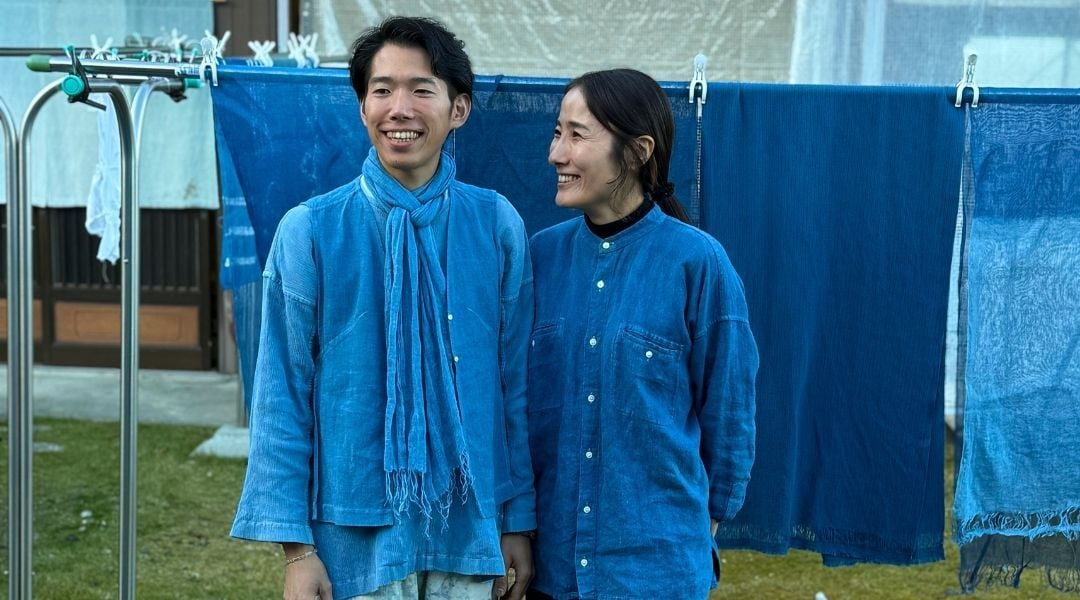
Embracing the natural healing qualities of true indigo, Kazuya designs and sews each garment by hand, while Miki brings them to life through dyeing and shibori. Miki, a clothing artist and indigo dyer, has extensive experience working with natural dyes and textiles. Her approach focuses on creating garments and everyday items that are easy to incorporate into life, regardless of age or gender. In 2020, she mastered the Hondate Sho-Aizome technique and continues to pursue indigo dyeing that is both vivid and exceptionally durable.
Our Experience
To reach them, we travelled by bullet train and JR train to Gifu, where Kazuya collected us - fittingly - in an indigo blue car. From there, we drove through green tea plantations toward their home and workshop, nestled at the base of a mountain. It was late November, crisp and clear, with wide blue skies, one of those days that already feels like a gift before it even begins.
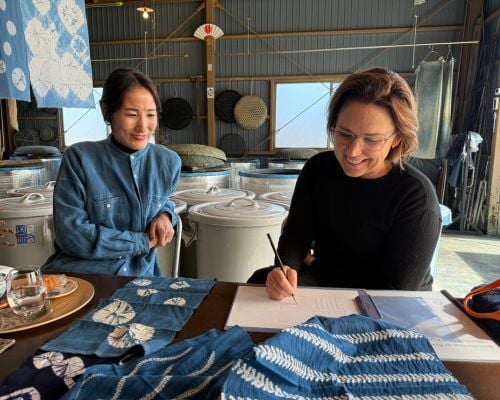
Miki welcomed us with green tea and a small Japanese cake, and we sat together at a table surrounded by books, dried indigo leaves, and tools of their practice. Kazuya walked us through the indigo process - from plant to vat - explaining that Hondate Sho-Aizome uses just two primary materials:
- Sukumo - fermented indigo leaf compost
- Lye - made from wood ash
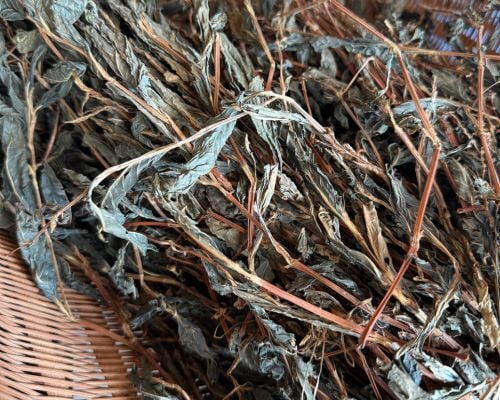
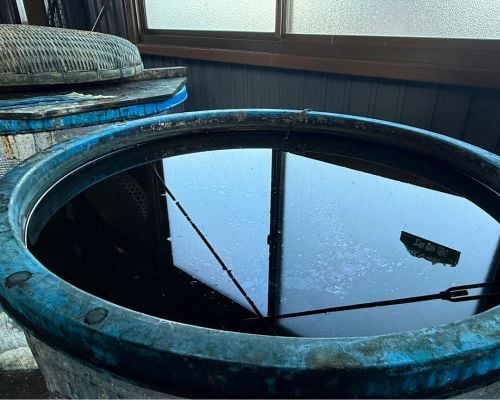
This minimalist approach leaves no room for error. The vat must be carefully mixed and constantly monitored, with attention paid to temperature, fermentation, and subtle shifts in condition. The indigo dye solution itself is called ai-date, while the act of dyeing fabric using this method is known as sho-aizome.
What moved me deeply was learning how much reverence they show not only to the dyeing process, but to the growing of the indigo itself. Although the indigo had already been harvested by the time we visited, Kazuya and Miki spoke about cultivating their fields using fermented liquids designed to activate indigenous microorganisms in the soil. Listening to this, I was reminded of Rudolf Steiner’s biodynamic “500” preparation, which similarly works to awaken microbial life and vitality in the earth. It was powerful to realise that these principles have been practiced in Japan for generations - quietly, consistently, and with great care.
For our workshop, we chose to explore shibori. Sitting with Miki, we spent about an hour learning and practising traditional tying techniques before dyeing. We were able to choose from scarves, fabrics, or garments, and I brought along a wool scarf of my own. There was something deeply meaningful about dyeing an object already woven into my life.
Before working with the indigo vat, we practised the movements in large tubs of clear mountain water. Entering and exiting the vat is both ceremonial and technical - the fabric must be moved gently beneath the surface to avoid introducing oxygen, which can disrupt the fermentation process. Even in practice, it was clear that this is a skill learned through repetition and presence.
When we finally immersed our hands in the indigo vat, I was surprised by the texture - warm, thick, almost soupy. Indigo vats are highly alkaline, and after some time we learned they can irritate the skin. Gloves are recommended for sensitive hands, but we chose to work barehanded, fully experiencing the process (and accepting the blue-stained fingers and sore skin that came with it).
The dyeing itself followed a rhythm:
scouring (alkalising) → dyeing → rinsing → sun-drying
Whilst the dyeing itself was quiet and reverent, the rinsing process was vigorous and full of energy. Moving gently from the indigo vat into the first rinsing tub, and then into clear mountain water, the fabric was washed vigorously and with energy. It was extraordinary to watch the colour transform before our eyes, shifting from a murky green to a vibrant, living blue as the dye oxidised in contact with air and water, before finally being hung out to dry.
Sun-drying plays a crucial role. Ultraviolet rays help stabilise the dye and reveal any residual lye on the fabric’s surface. Typically, this cycle is repeated at least six times to ensure the colour is deeply fixed and long-lasting. With limited time, we allowed each stage to unfold as fully as possible before beginning our second and final immersion.
By the end of the day, it was clear this experience was about far more than colour. It was about time, patience, respect, and working in relationship with living systems. Watching the reverence Kazuya and Miki hold for their vats, their land, and their practice was profoundly moving.
Both Jo and I left feeling deeply nourished, not just creatively, but humanly. If you have a spare day in Japan and want to support a young fashion label preserving traditional techniques that are quietly disappearing, I cannot recommend AIWAYU enough. We brought our pieces home with us, knowing they will be worn, loved, and carried for many years to come.
.jpg?width=469&height=375&name=Take%20Two%20Team%20Indigo%20Dyeing%20(1).jpg)

Ang is the Founder of Fibre Arts Take Two.